
Performance marketing KPIs help businesses measure whether advertising and marketing investments are producing meaningful outcomes such as leads, conversions, revenue and profitable customer acquisition. Important metrics such as CTR, CPC, conversion rate, CPA, CAC, ROAS, ROI and customer lifetime value (LTV) provide a clearer picture of campaign efficiency and financial performance.
An effective performance marketing measurement strategy should connect KPIs with business goals, the customer journey and profitability. Businesses should analyse the complete marketing funnel, improve creatives and landing pages, refine audience targeting and allocate budgets towards campaigns that generate stronger, sustainable returns.
Performance marketing is built around one simple principle: marketing investment should produce measurable business outcomes. Instead of evaluating campaigns only through visibility, impressions, or reach, performance marketing connects marketing activity with actions such as clicks, enquiries, leads, sales, subscriptions, and revenue.
This approach is becoming increasingly important as businesses continue to invest more heavily in digital advertising. According to the IAB/PwC Internet Advertising Revenue Report, U.S. digital advertising revenue reached $294.6 billion in 2025, representing 13.9% year-over-year growth. As digital investment increases, businesses need stronger measurement systems to understand whether their marketing budget is actually generating profitable growth.
This is where professional performance marketing services become valuable. Businesses today have access to hundreds of data points across advertising platforms, analytics tools, CRM systems, websites, and sales platforms. However, having more data does not automatically lead to better decisions.
By focusing on the right performance marketing KPIs, businesses can understand campaign efficiency, identify growth opportunities, control acquisition costs, improve profitability, and make better marketing decisions.
Performance marketing KPIs are measurable values used to determine whether marketing activities are achieving specific business objectives.
A KPI may measure campaign engagement, customer acquisition efficiency, sales performance, revenue generation, or profitability. The most useful KPIs connect marketing activities directly with meaningful outcomes.
It is also important to understand the difference between a metric and a KPI.
A metric is any measurable data point. Examples include impressions, clicks, page views, video views, and sessions.
A KPI, on the other hand, is a metric that is directly connected to an important business objective.
For example, if a business wants to generate more qualified leads, cost per lead and lead-to-customer conversion rate may be important KPIs. If the objective is ecommerce revenue, conversion rate, ROAS, CAC, and average order value may become more important.
Businesses therefore should not track performance marketing KPIs metrics simply because the data is available. Each KPI should provide information that supports a decision.
The goal is not to create the largest dashboard possible. The goal is to create a measurement framework that helps the business understand whether its marketing investment is producing the expected results.

Performance marketing KPIs help businesses move from assumptions to measurable decision-making.
Without clearly defined KPIs, marketers may know how many people viewed an advertisement or visited a website but still have difficulty explaining whether the campaign contributed to revenue or profitability.
A qualified performance marketing expert uses KPIs to evaluate the complete relationship between marketing investment and business outcomes.
Effective KPI measurement can help a business:
The right KPIs also provide context. A campaign may generate thousands of clicks, but those clicks have limited value if visitors do not convert. Similarly, a campaign may deliver a high number of conversions but still be unprofitable if customer acquisition costs are too high.
Performance marketing measurement should therefore connect engagement, conversion, acquisition cost, customer value, and revenue.
Also Read : How to Rank in AI Overviews: A Complete Guide for Businesses in 2026
Click-through rate measures the percentage of people who click an advertisement after seeing it.
CTR = Clicks ÷ Impressions × 100
For example, if an advertisement receives 10,000 impressions and generates 300 clicks, its CTR is 3%.
CTR helps businesses evaluate whether an advertisement is attracting attention and encouraging users to take the next step.
A low CTR may indicate problems with:
CTR should not be viewed independently, however. A high CTR is valuable only when those clicks contribute to meaningful conversions.
Cost per click measures how much a business pays, on average, for each advertising click.
CPC = Total Advertising Cost ÷ Total Clicks
If a campaign spends $2,000 and generates 1,000 clicks, the average CPC is $2.
Monitoring CPC helps marketers understand traffic acquisition costs and compare campaign efficiency.
A rising CPC does not automatically mean a campaign is performing poorly. Paying more for clicks may still be worthwhile if those users have higher purchase intent or generate greater customer value.
CPC should therefore be analysed alongside conversion rate, CPA, and ROAS.
Conversion rate measures the percentage of visitors or users who complete a desired action.
A conversion could include:
Conversion Rate = Conversions ÷ Visitors or Clicks × 100
Conversion rate is particularly important because it connects traffic with business outcomes.
If campaigns generate strong traffic but poor conversions, the issue may exist within the landing page, offer, user experience, audience targeting, or sales journey.
Improving conversion rate can help generate more results from existing traffic without necessarily increasing advertising expenditure.
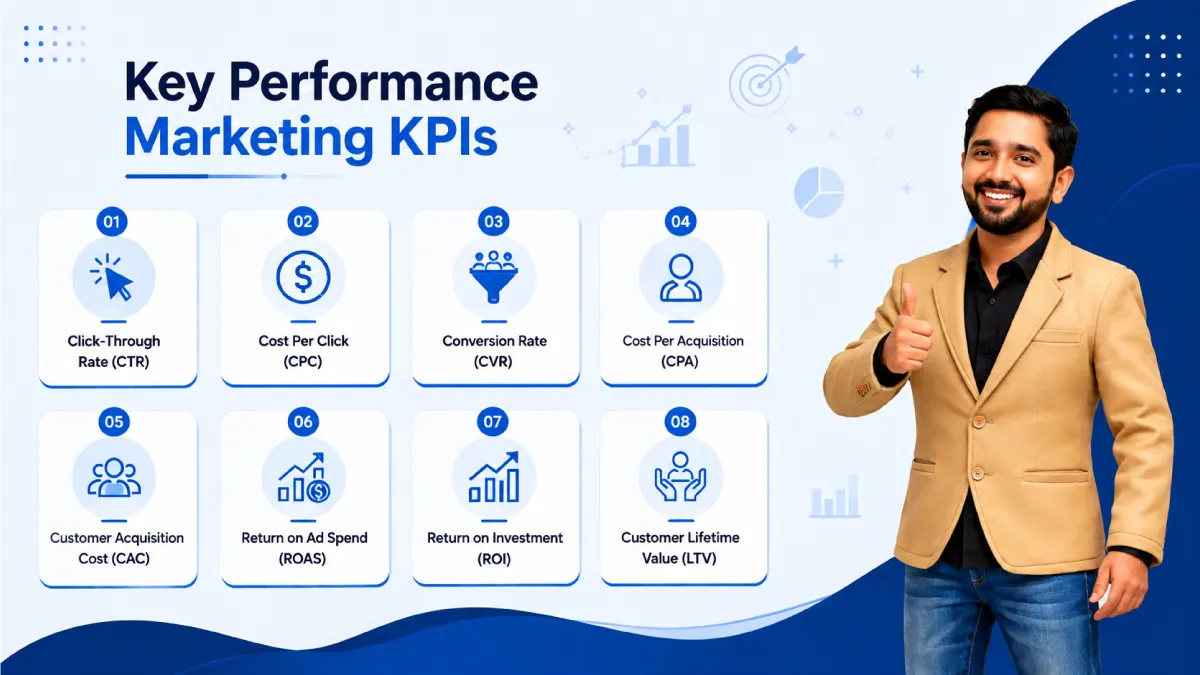
Cost per acquisition measures how much marketing spend is required to generate a defined acquisition or conversion.
CPA = Total Campaign Cost ÷ Total Acquisitions
Suppose a company spends $10,000 and generates 200 customers. The CPA would be $50.
CPA allows businesses to evaluate whether customer acquisition is financially sustainable.
However, acceptable CPA will vary considerably between businesses. A company selling a $50 product cannot evaluate CPA in the same way as a B2B organisation selling a £50,000 enterprise solution.
The KPI must always be evaluated against revenue, margins, and customer value.
Customer acquisition cost measures the total cost involved in acquiring a new customer.
Unlike campaign-level CPA, CAC can include broader sales and marketing expenses such as:
CAC = Total Sales and Marketing Costs ÷ New Customers Acquired
CAC provides business leaders with a wider view of acquisition efficiency.
If customer acquisition costs continue increasing while customer value remains unchanged, long-term profitability can become difficult.
This is why CAC is often analysed alongside customer lifetime value.
Return on ad spend measures how much advertising revenue is generated for every unit of advertising spend.
ROAS = Revenue Attributed to Advertising ÷ Advertising Spend
For example, if a business spends $20,000 on advertising and generates $100,000 in attributed revenue:
ROAS = 5:1
This means the business generated $5 in revenue for every $1 spent on advertising.
ROAS is particularly useful when comparing paid campaigns, channels, products, audiences, and advertising strategies.
However, ROAS measures revenue rather than total profitability. Businesses must still consider operational expenses, margins, returns, discounts, and other costs.
ROI provides a broader measurement of financial performance.
While ROAS focuses primarily on advertising expenditure and attributed revenue, ROI evaluates whether the overall investment produced a financial return.
For business decision-makers, ROI can provide a clearer picture of whether marketing activities are actually contributing to profitable growth.
A campaign may have an impressive ROAS but a much smaller ROI after additional operating and fulfilment costs are considered.
Customer lifetime value estimates how much financial value a customer may generate throughout their relationship with a business.
LTV becomes especially important for subscription businesses, SaaS companies, ecommerce brands, financial services companies, and businesses where customers regularly make repeat purchases.
When LTV is significantly higher than CAC, a business may have greater flexibility to invest in customer acquisition.
For example, spending $300 to acquire a customer could appear expensive if their first transaction generates only $150. But if that customer generates $2,000 over their relationship with the company, the acquisition economics look very different.
Tracking LTV allows marketers to optimise towards valuable customers rather than simply the cheapest conversions.
Not every business needs to prioritise the same KPIs. The right selection depends on business goals, customer journeys, marketing channels, margins, and growth strategy.
Begin by defining what the campaign needs to achieve.
Possible objectives include:
Then choose KPIs that directly measure progress towards those objectives.
For example, an awareness campaign might initially track reach and engagement, while a customer acquisition campaign should place greater emphasis on CPA, CAC, conversion rate, and revenue.
Different KPIs provide information about different stages of the funnel.
At the awareness stage, businesses may track impressions, reach, and engagement.
At the consideration stage, CTR, CPC, landing page engagement, and lead generation become more useful.
At the conversion stage, businesses may prioritise CVR, CPA, CAC, revenue, and ROAS.
Looking at the complete funnel makes it easier to identify performance gaps instead of judging an entire campaign through one number.
Marketing teams can become too focused on platform-level performance while ignoring wider commercial outcomes.
Ultimately, marketing should contribute to sustainable business growth.
Businesses should therefore connect marketing data with:
The best KPI framework tells both marketers and business leaders whether growth is commercially valuable.
Even businesses with extensive analytics systems can make poor decisions when KPIs are interpreted incorrectly.
One common mistake is focusing excessively on vanity metrics such as impressions, likes, followers, or traffic without understanding whether they influence leads or revenue.
Another problem is tracking too many KPIs. When every metric receives equal importance, teams may struggle to identify which numbers require action.
A skilled performance marketing specialist can help businesses separate useful performance indicators from supporting metrics.
Other common mistakes include:
Businesses should also avoid treating KPI targets as permanent. Customer behaviour, media costs, competitors, platforms, pricing, and business priorities can change over time.
Measurement frameworks should evolve with the business.
Also Read : GEO Best Practices: How Businesses Can Rank in AI-Powered Search Results
Performance marketing should be continuously evaluated rather than reviewed only at the end of a campaign.
Monitor campaign results and identify meaningful patterns across:
Use this information to test new approaches and gradually improve campaign efficiency.
Strong targeting cannot compensate for poor creative or a weak landing page.
Advertisements should clearly communicate:
Landing pages should continue the same message and make conversion as simple as possible.
Test headlines, calls to action, layouts, forms, visuals, offers, and messaging to identify combinations that improve engagement and conversions.
Campaign results frequently vary significantly between audience segments.
Businesses should identify which customer profiles generate the strongest combination of conversion rate, customer value, and profitability.
Audience analysis can include:
Instead of simply finding the largest audience, focus on finding audiences that are most valuable to the business.
Marketing budgets should not remain fixed simply because they were originally planned that way.
Campaign performance can help businesses determine where additional investment is likely to create the greatest return.
Increase investment where campaigns demonstrate sustainable customer acquisition and strong profitability.
At the same time, reduce, pause, or restructure campaigns that consistently produce poor-quality leads, excessive acquisition costs, or weak returns.
Budget optimisation should focus on profitable growth rather than simply increasing advertising volume.

Tracking the right performance marketing KPIs helps businesses understand which campaigns, channels, and strategies are contributing to meaningful results. By focusing on metrics connected to conversions, acquisition costs, revenue, and customer value, businesses can measure marketing efficiency more accurately and identify opportunities for sustainable growth.
Effective performance marketing consulting helps turn campaign data into practical insights. By analysing KPI trends, businesses can identify underperforming areas, optimise targeting and creatives, improve conversion rates, and allocate marketing budgets towards campaigns that generate stronger returns.
The real value of performance marketing data lies in how it is used. Businesses that regularly review the right KPIs and act on data-driven insights can reduce wasted spend, improve campaign performance, and make smarter marketing decisions that support long-term business growth.
Track KPIs that support business goals: Focus on metrics directly connected to revenue, leads, customer acquisition and retention.
Focus on profitability, not just clicks: Use CPA, CAC, ROAS, ROI and LTV to understand the real commercial value of campaigns.
Measure the complete marketing funnel: Analyse awareness, consideration and conversion metrics together to identify performance gaps.
Connect marketing data with customer value: Compare acquisition costs with revenue, margins and customer lifetime value to measure sustainable growth.
Optimise campaigns continuously: Regularly review audiences, creatives, landing pages, channels and budgets to improve performance and marketing ROI.

Mit Thakkar is a digital marketing consultant helping businesses improve SEO, AI Overview visibility, and AI search performance. He focuses on AIO, GEO, content strategy, EEAT, schema, and topical authority to help brands create helpful content that can rank better in Google Search and appear across AI-driven search experiences.